
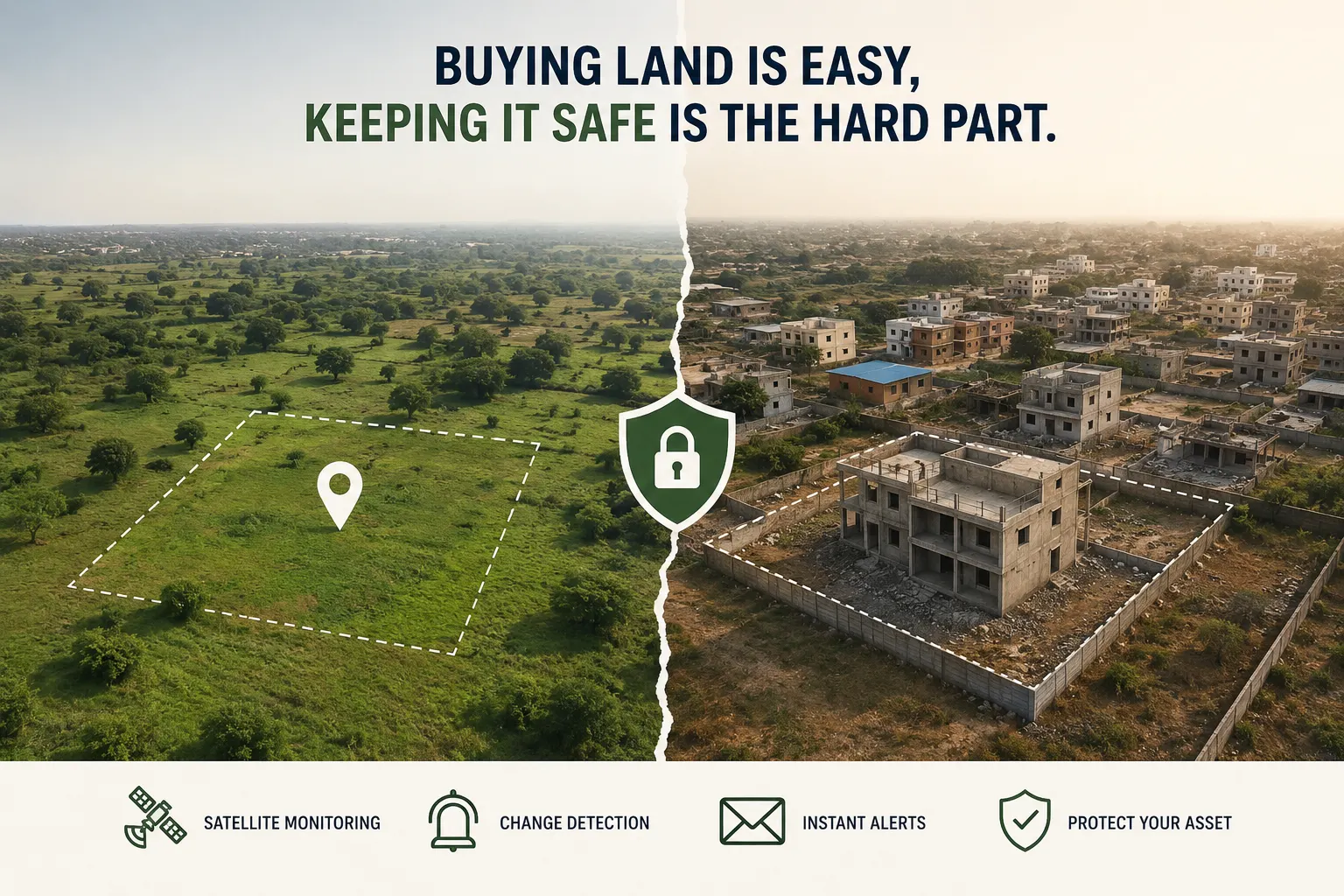
Buying Land Is Easy. Keeping It Safe Is the Hard Part.
For many families, buying land is one of the biggest financial decisions they will ever make. The registration is completed, the documents are safely stored, and there is a sense of relief that the property is now secure.
But ownership on paper and protection in reality are two very different things.
Unlike a home, a shop, or a vehicle, land often remains unattended. There are no monthly reminders to visit it, no regular maintenance schedules, and in many cases, no one living nearby to keep an eye on it.
Years can pass without the owner ever setting foot on the property.
Unfortunately, that is exactly what makes vacant land vulnerable.
The Story Shared by Thousands of Families
Across India, countless land parcels are inherited rather than purchased.
Agricultural fields, village plots, orchards, and ancestral properties are passed from one generation to the next. Meanwhile, families move to cities for education, employment, or business. Children settle in Mumbai, Pune, Bengaluru, Dubai, London, or New York, while the family land remains hundreds or even thousands of kilometres away.
Initially, someone in the family keeps track of the property.
Over time, life becomes busy.
The annual visit becomes an occasional visit.
Occasional visits become once every five or ten years.
The land slowly disappears from everyday conversations.
Until one day someone decides to visit.
And that visit changes everything.
What Owners Sometimes Find
The expectation is simple: the land should look exactly as it did years ago.
Reality can be very different.
Sometimes there is a newly built compound wall.
Sometimes construction material is lying on the plot.
Sometimes temporary sheds have appeared.
Sometimes agricultural activity has started.
In more serious situations, permanent buildings have already been constructed.
What makes these situations particularly painful is that they rarely happen overnight.
Encroachment is often gradual.
A few feet today.
A small structure tomorrow.
An extension a year later.
Each individual change seems insignificant. Collectively, they transform the entire property.
By the time the actual owner becomes aware, the situation has already become much more difficult to resolve.
The Cost of Discovering Too Late
Finding an encroachment years after it begins creates problems that go far beyond repairing a boundary wall.
Once construction exists, ownership disputes often become legal disputes.
The process may involve revenue records, title documents, historical maps, land surveys, witness statements, government departments, and repeated court hearings.
In India, many land disputes continue for years.
Some continue for decades.
Even when the rightful owner eventually succeeds, the financial cost, emotional stress, and time invested can far exceed the original value of the disputed land.
The difficult reality is that the problem is often not the encroachment itself.
The problem is discovering it years after it started.
The Timeline Nobody Wants

This sequence is unfortunately more common than many people realise.
Imagine If the Timeline Changed
Now consider a different scenario.
Instead of visiting the property after seven years, the owner becomes aware that something has changed on monthly basis.
A new structure appears.
The surrounding land changes.
Vegetation is suddenly cleared.
Road access begins to develop.
Instead of learning about these changes years later, the owner knows while the situation is still developing.
The response can be faster.
The inspection can happen sooner.
The documentation can begin earlier.
And in many cases, small problems can be addressed before they become major legal battles.
The difference isn't ownership.
The difference is awareness.
Satellites Quietly Watch the Earth Every Few Days
Modern Earth observation satellites continuously capture imagery of almost every location on the planet.
This technology has traditionally been used by governments, researchers, environmental organisations, and large enterprises.
Today, the same capability can help individual landowners stay informed about changes occurring around their own property.
Satellite monitoring cannot replace legal surveys.
It cannot determine ownership.
It cannot prevent illegal activity.
But it can answer a very important question:
"Has anything changed on my land since the last time I checked?"
Sometimes that single piece of information is enough to trigger an early site visit before the situation becomes significantly worse.
From Periodic Visits to Continuous Awareness
For decades, land ownership followed a simple pattern.
Visit the property whenever time permits.
Hope everything is unchanged.
Repeat after another few years.
Technology now makes a different approach possible.
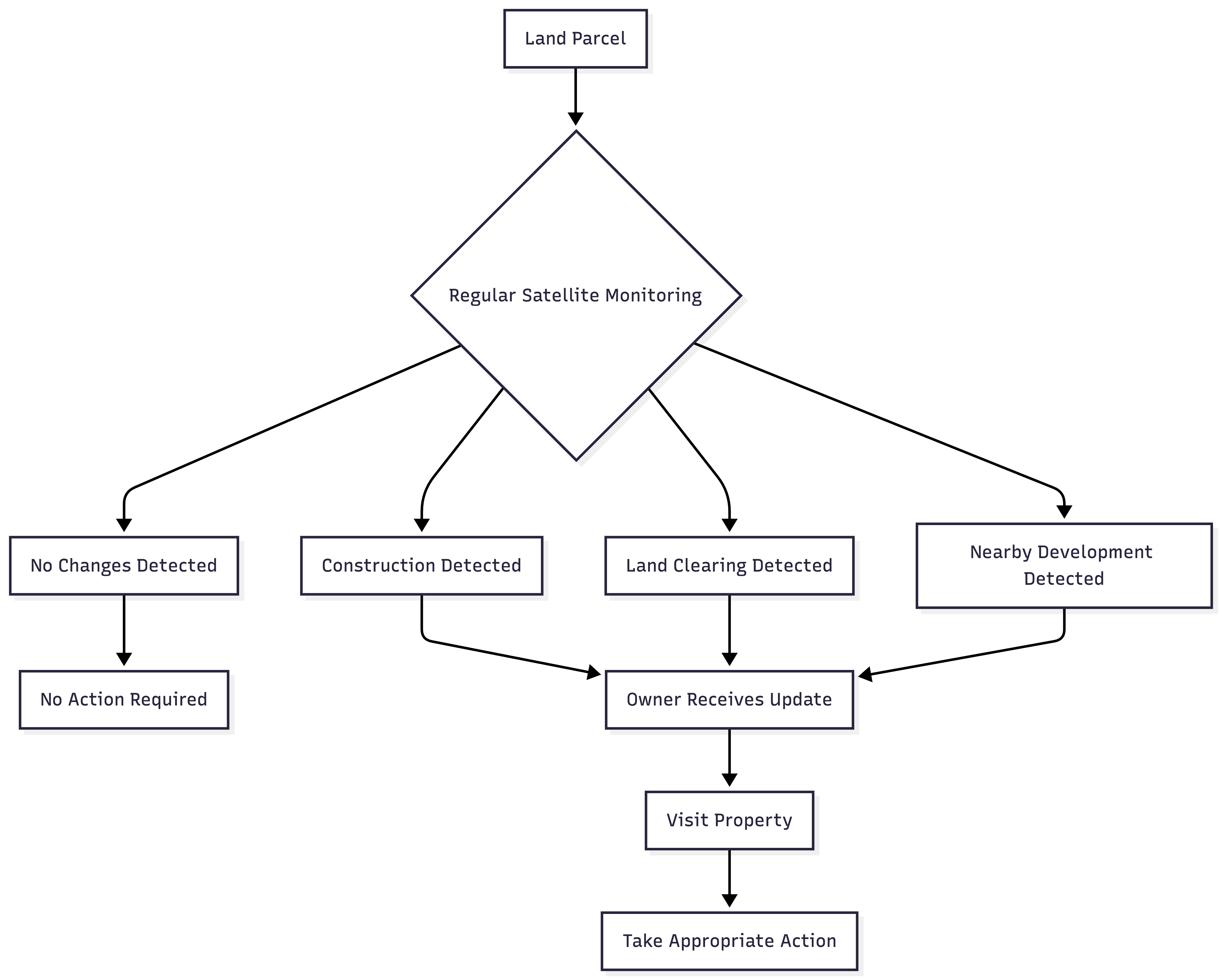
Instead of relying entirely on occasional physical visits, owners can remain informed throughout the year.
Why WatchMyPlots Exists
WatchMyPlots was built around a simple observation.
Most people monitor their bank accounts daily.
Their vehicles can be tracked in real time.
Mobile phones immediately notify them about suspicious activity.
Yet one of the most valuable assets a family owns—its land—is often left completely unmonitored.
The goal of WatchMyPlots is not to replace surveyors, lawyers, or government records.
Its purpose is much simpler.
To help landowners know when their land deserves attention.
Because buying land is usually a one-time event.
Protecting it is an ongoing responsibility.
And in many situations, knowing early can make all the difference.