
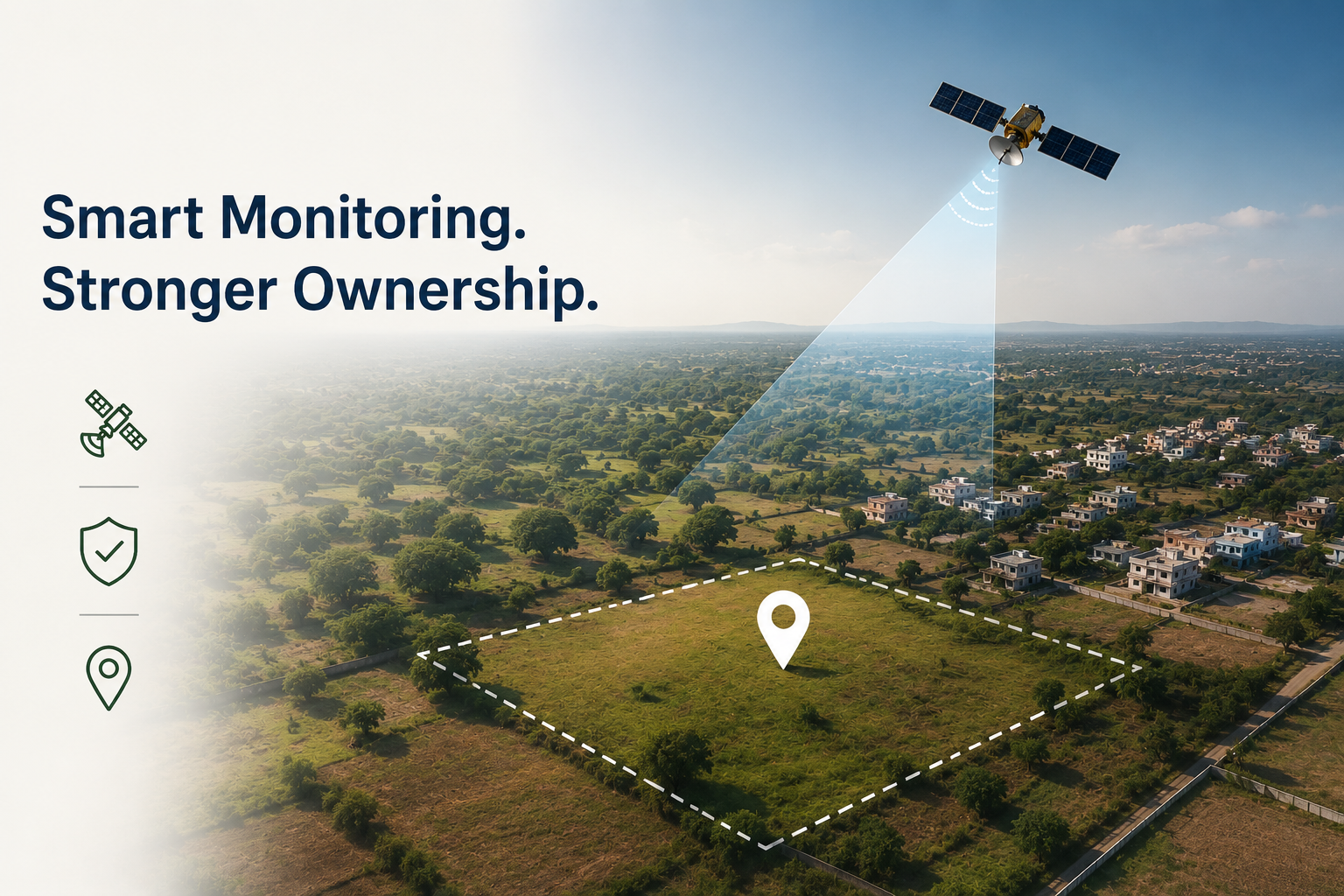
Why Satellite Monitoring Makes Sense for Middle-Class Landowners
For most middle-class families, buying a piece of land is one of life's biggest milestones. Unlike stocks or mutual funds that can be purchased gradually, land often requires years of disciplined savings, careful financial planning, and in many cases, a loan that takes years to repay.
The purchase is rarely just about owning a piece of property. It represents future security. It could be the site of a dream home, an investment for children, or simply a financial asset that is expected to appreciate over time.
Yet once the registration is complete, many landowners discover an uncomfortable reality.
Buying the land was expensive, but protecting it can be even more challenging.
The Protection Problem Nobody Talks About
When people calculate the cost of buying land, they usually account for the purchase price, stamp duty, registration charges, and perhaps the cost of fencing.
What often gets overlooked is the long-term cost of simply keeping an eye on the property.
Vacant land doesn't require monthly maintenance like an apartment, but it does require periodic attention. Boundaries need to be checked, nearby developments observed, and any unexpected activity identified before it becomes a larger problem.
For many middle-class families, this is easier said than done.
The property may be located in another district or another state. Visiting it regularly means taking time off work, arranging transportation, and spending an entire day—or sometimes an entire weekend—just to confirm that nothing has changed.
As life becomes busier, these visits naturally become less frequent.
Large Investors Have More Options
Large real estate companies and institutional investors approach this problem very differently.
When they acquire land, they also allocate a budget for protecting it. Depending on the size and value of the property, they may appoint caretakers, hire private security guards, construct compound walls, install surveillance systems, or conduct regular site inspections through dedicated staff.
If a dispute arises, they usually have the financial resources to engage experienced legal teams and respond quickly.
For them, monitoring land is simply another operational expense.
Most middle-class families don't have that luxury.
Why Traditional Security Doesn't Always Work
A common response to land protection is, "Just build a fence."
While fencing is certainly useful in many situations, it isn't always practical.
A compound wall around a large plot can cost several lakhs. Even simple fencing requires maintenance and periodic repairs. In remote locations, fences may be damaged by weather, animals, or even deliberately removed.
Another suggestion is to install CCTV cameras.
Again, this sounds reasonable until the practical challenges become clear. Vacant land often lacks reliable electricity and internet connectivity. Cameras require maintenance, and someone still needs to review the footage. A surveillance system is only useful if it is operational and regularly monitored.
Hiring a security guard is another option, but it introduces recurring monthly expenses that many families simply cannot justify for a single plot of land.
None of these solutions are inherently wrong. They are simply designed for situations where ongoing expenditure is not a major concern.
The Real Question Is Simpler
Instead of asking:
"How can I watch my land every single day?"
Perhaps the better question is:
"How can I know when my land actually needs my attention?"
That subtle shift changes the entire approach.
Most days, nothing happens.
There is no new construction.
No major land clearing.
No nearby development that requires immediate action.
If owners could reliably know that nothing has changed, they could avoid unnecessary trips and focus only on situations that genuinely deserve attention.
This Is Where Satellite Monitoring Fits In
Modern Earth observation satellites capture fresh imagery of almost every part of the planet at regular intervals. While these satellites were once used primarily by governments and scientific organisations, advances in technology have made satellite-based monitoring accessible for individual landowners as well.
Satellite monitoring does not replace legal ownership documents, physical surveys, or site visits.
Instead, it serves a different purpose.
It provides visibility.
Rather than relying solely on occasional inspections, landowners can receive updates when meaningful changes occur around their property. New construction, land clearing, changes in surrounding development, or other visible alterations can be identified much earlier than they might be through traditional methods alone.
Early awareness gives owners something valuable: the ability to make informed decisions.
Sometimes the right decision is to visit the property immediately.
Sometimes it is simply to continue monitoring because the observed change has no impact on the land.
The important difference is that the decision is based on information rather than assumption.
Comparing the Approaches
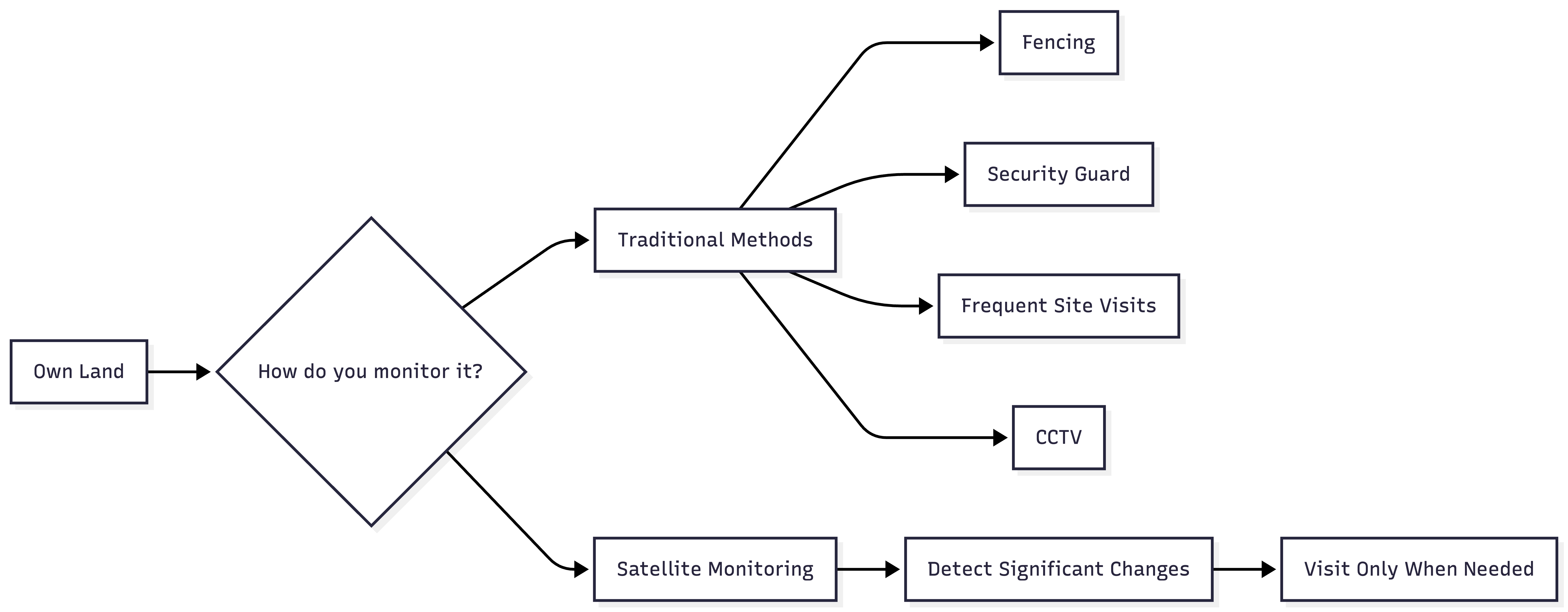
Satellite monitoring is not intended to replace every traditional method. Instead, it complements them by helping owners understand when those methods need to be used.
Making Better Use of Time and Money
One of the biggest advantages of satellite monitoring is that it helps optimize both time and cost.
Instead of scheduling regular visits simply because "it's been a while," owners can prioritize visits based on actual activity around the property.
Instead of assuming everything is fine—or assuming the worst—they have access to recent information that supports better decisions.
This is particularly valuable for middle-class families, where both time and money are limited resources.
The objective isn't to eliminate every expense associated with land ownership. Rather, it is to ensure that expenses are incurred when they are genuinely necessary.
Technology Is Becoming an Equalizer
For many years, continuous land monitoring was a capability reserved for governments, infrastructure companies, and large developers with substantial budgets.
Today, satellite technology is changing that equation.
It enables individual landowners to benefit from many of the same monitoring capabilities without employing full-time security personnel or making frequent long-distance visits.
Technology cannot physically stop an encroachment.
It cannot replace legal due diligence.
It cannot resolve ownership disputes.
What it can do is reduce the time between a change occurring and the owner becoming aware of it.
In many situations, that difference can be significant.
Why WatchMyPlots Was Built
WatchMyPlots was created with a simple objective: to make modern satellite monitoring accessible to ordinary landowners.
Rather than expecting owners to repeatedly travel to their property—or invest in expensive security infrastructure—WatchMyPlots uses satellite imagery to monitor land parcels for visible changes. When meaningful activity is detected, owners receive timely updates so they can decide whether a physical visit or further investigation is required.
For large organizations, land monitoring has always been part of doing business.
For middle-class families, it has often been too expensive or too inconvenient.
Satellite technology is helping bridge that gap.
Because protecting your land shouldn't depend on how much you can afford to spend after buying it. It should depend on how quickly you can know when something has changed.